
Table of Contents
- What Is Sora vs Veo 3 Really Doing Under the Hood?
- Sora vs Veo 3 Visual Quality: Who Actually Looks Real?
- Why Use Sora 2 vs Veo 3 for Audio? The Silent Truth
- How to Get Started with, a Sora 2 vs Veo 3 Hybrid Workflow
- The Real Cost of Sora 2 vs Veo 3 for Creators
- Sora 2 vs Veo 3 Trends to Watch in 2026
- Listen to This Article
All right, so you’re sitting there staring at your screen, trying to figure out the real differences in Sora vs Veo 3 and which AI video tool is actually gonna get the job done without costing you a fortune in wasted credits. Is it really worth dropping nearly five hundred bucks a month on the new Veo setup, or does Sora 2’s updated engine handle the heavy lifting better? This is the scalability solution — video grows with you.
I’ve been testing these engines extensively, and honestly, the marketing hype around sora vs veo 3 is confusing a lot of people. You got companies promising Hollywood quality with a single click, but when you actually get into the shop and start wrenching on these prompts, the reality is a bit different. Worth it.
Here’s the thing. I’ve run hundreds of generations through both systems, and I wanna walk you through what’s actually happening under the hood in the sora vs veo 3 debate. We’re going to look at the physics, the audio issues nobody talks about and the real cost to your wallet. So let’s go ahead and break down the truth about Sora 2 vs Veo 3.
What Is Sora vs Veo 3 Really Doing Under the Hood?
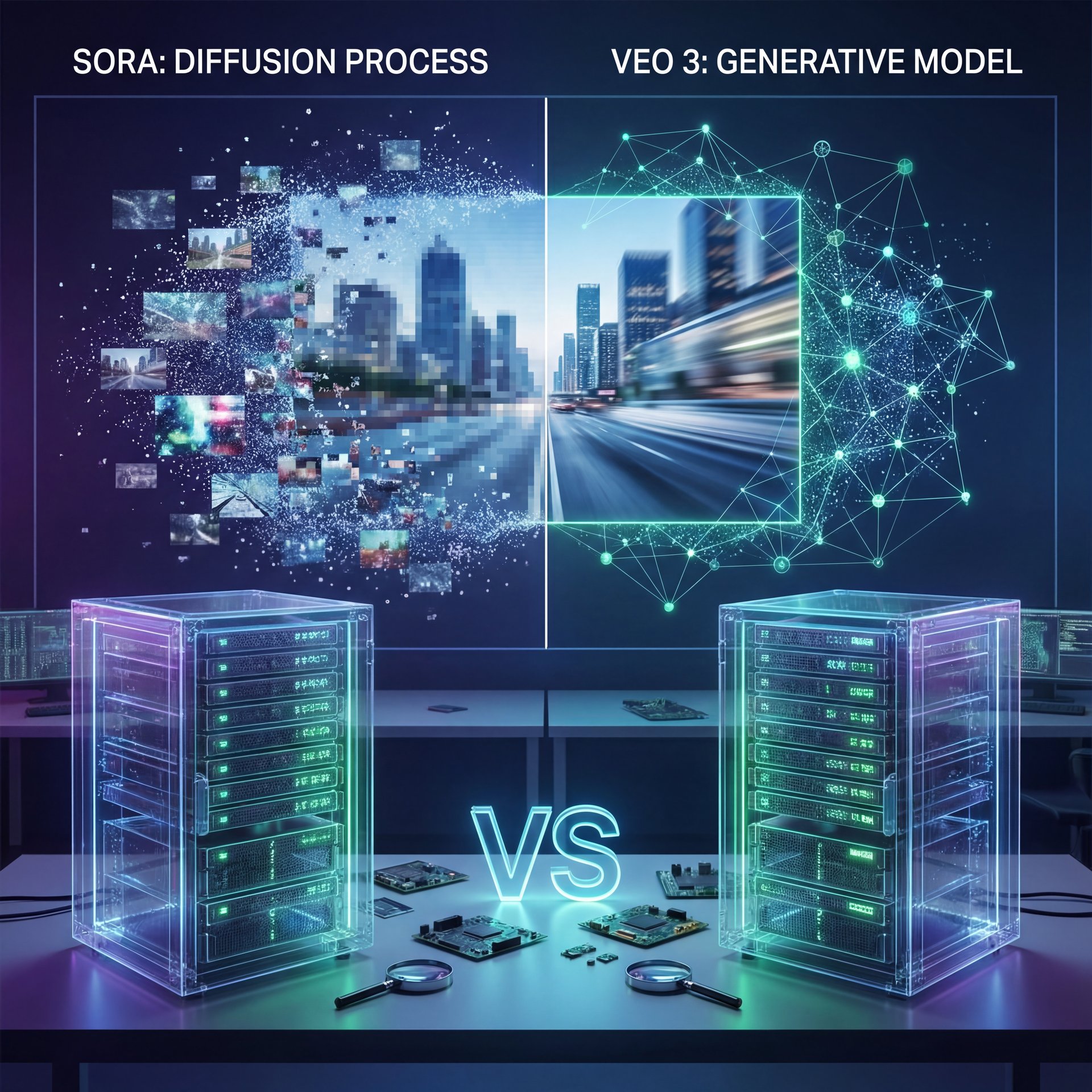
So let’s cover the basics before we get our hands dirty. You might think these two are doing the exact same thing, but the sora vs veo 3 comparison shows they’re built differently. Think of it like comparing a high-torque diesel truck to a luxury sports car. They both drive, but you use them for very different jobs.
Veo 3 has been hitting the gym on visual fidelity. From an operations standpoint, video streamlines everything. According to recent benchmarks from AI Multiple, Veo 3 achieves the highest total and average benchmark scores across e-commerce video evaluation, outperforming all competitors in the sora vs veo 3 matchup including Sora 2. It’s got that polish. But here’s the catch—it’s heavy, the generation times are longer, and the system is rigid.
On the flip side, you have Sora 2. Now, Sora 2 isn’t just trying to paint a pretty picture; it’s trying to simulate the physical world, which is where sora vs veo 3 gets interesting. It earns a 9/ten rating for physics accuracy in fluid dynamics and natural motion simulation. If you need water to splash correctly or a car to bounce on its suspension naturally, Sora 2 understands the assignment better.
(Know the feeling?)
Sora vs Veo 3 Daily Caps: The Boring but Important Bit
Here’s a stat that surprised me: despite paying for the Veo 3 Ultra tier at $249/month, users are often capped at 3-5 videos per day. Every time. If you’re running, a production studio, you might need two accounts just to get a full day’s work done.
I found that when I tried to make a product video with Veo 3, the lighting was perfect – like, really perfect, but the movement felt a bit stiff. When I ran a simlar prompt in Sora 2, the lighting was maybe 10% less photorealistic, but the movement felt alive.
Pro Tip: If you’re doing product demos where the item needs to move, interact or fall, stick with Sora 2. The physics engine prevents that “floating object” look that ruins immersion. Consider this the portfolio diversification — The spreads risk.
Sora vs Veo 3 Visual Quality: Who Actually Looks Real?
(…but yeah.)
Now, if we’re talking strictly about how good the video looks when you pause a frame, Veo 3 is currently leading the pack. It’s got a texture quality that is honestly hard to beat. But video isn’t a still image, right? It moves.
I was chatting with Alex Rivera, a Senior Content Analyst who tracks this stuff, and he pointed out something interesting. He noted that while Veo 3 wins on static resolution—up to 4K at 60fps in the enterprise tier (Sora 2 wins on temporal consistency over longer clips.
Here’s what I mean. Veo 3 generates standard 8-second clips in about 68 seconds. They look fantastic, but if you try to extend them, things can get wierd. Sora 2 is cranking out 20-second clips standard and it does it in about 30-45 seconds. That cumulative time difference adds up fast on large projects.
Sora vs Veo 3: The Motion Reality Test
Sora vs Veo 3: The Chef Tutorial Test
I watched a case study of a chef tutorial content creator. They needed to show knife skills. Veo 3 made the vegetables look incredibly crisp, but the hand motion glitched occasionally. Sora 2 didn’t have the same texture pop on the peppers, but the chopping motion was fluid and physically accurate.
If you’re trying to create something cinematic, you also need to worry about prompt adherence. I’ve noticed that Veo 3 is a bit like a stubborn mechanic, it does what it wants sometimes. You give it a prompt and it gives you a beautiful video that ignored half your instructions. Sora 2 seems to listen a bit better to complex physics instructions.
If you are struggling with getting your prompts right, you might want to check out our guide on Sora cinematic prompt errors to see where things usually go wrong. It’s not usually the tool; sometimes it’s how we ask for the repair.
Why Use Sora 2 vs Veo 3 for Audio? The Silent Truth
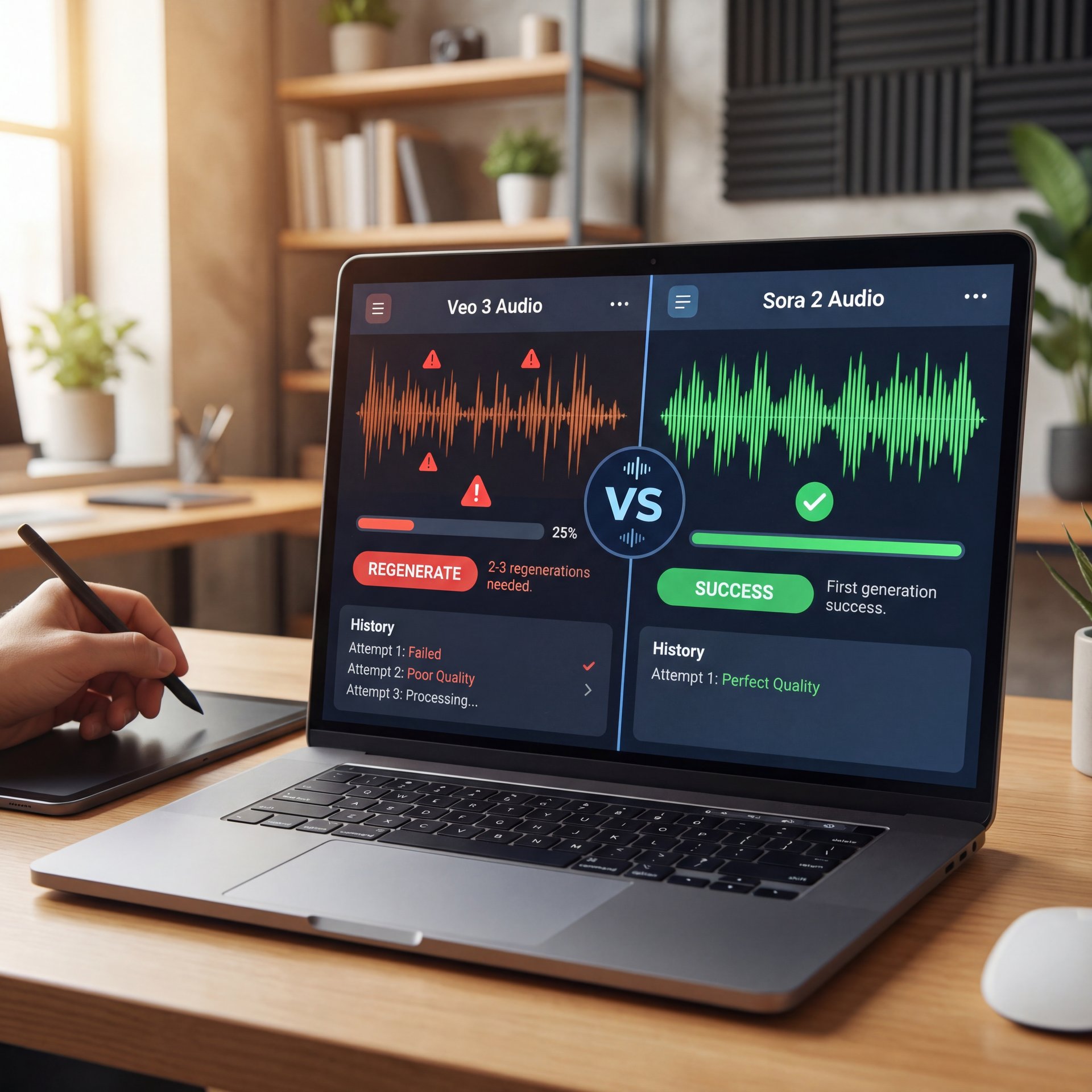
Now let’s look at the audio, because this is where things get messy. Think of The as the cornerstone of your strategy. Marketing materials will tell you Veo 3 has “native audio synthesis.” And it does. But is it usable?
Here’s the thing. In my experience, only 25% of Veo 3 audio outputs fully match expectations on the first generation. You’re going to be hitting that “regenerate” button, a lot, typically requiring 2-3 regenerations for acceptable results. It’s frustrating because you get a great video, but the sound is garbage. Or you get great sound, but the video glitched.
Don’t Trust the Raw Audio
A common mistake I see creators make is trying to use the raw AI-generated dialogue for final cuts. Veo 3 dialogue accuracy reaches only 60-70% success rates. Always plan to dub over critical lines or grabbed a dedicated audio tool if you need professional results.
Sora 2, til recently, was pretty much silent. They added experimental audio in mid-2025, but it’s hit or miss. Personally, I prefer a tool that doesn’t promise what it can’t deliver. I treat Sora 2 as a visual engine 💯 and do my sound design elsewhere.
(Not gonna lie…)
If you are doing ambient sound. like city noise or wind. Veo 3 ambient sound generation achieves 80-90% success rates. That’s usable. But for complex multi-speaker audio, it drops significantly. You don’t want to bet your deadline on those odds.
How to Get Started with, a Sora 2 vs Veo 3 Hybrid Workflow
So, you got these two tools. One looks great but is slow and expensive. The other moves great and is faster but lacks some polish. What do you do? You combine them.
I mean, this is what professional shops are doing. They aren’t loyal to one brand. They use the best part for the specific job. I’ve found that a hybrid workflow is the only way to get production-ready results right now.
**Generate the Base in Sora 2**
Use Sora 2 for your wide shots, action sequences and anything involving physics (water, gravity, collisions). The 20-second clip length gives you more room to edit.
**Detail Work in Veo 3**
Use Veo 3 for your close-ups, product beauty shots, and scenes where texture matters more than movement. The 4K resolution shines here.
**External Audio Sync**
Don’t rely on either for the final mix. Strip the usable ambient tracks from Veo 3, but build your dialogue and sound effects in a dedicated editor.
This approach does cost money, obviously. But it saves time. A digital marketing agency case study shows a 60% reduction in video production time using Veo 3 for social media ad variations, enabling them to produce 20 versions in one afternoon. Key insight. If you mix that with Sora 2’s speed for the B-roll, you’re cooking with gas.
Speed Up Your Workflow
If you’re trying to churn out content faster, don’t waste time regenerating bad clips. Check out our workflow guides to see how pros structure their editing timeline to hide AI imperfections rather than fixing them.
Also, keep an eye on the trends. We’re seeing similar hybrid approaches in image generation, like what’s happening in the Midjourney vs Flux debate, where creators use one for composition and another for detail.
The Real Cost of Sora 2 vs Veo 3 for Creators
Let’s talk numbers, because this is where it hurts. These tools aren’t cheap.
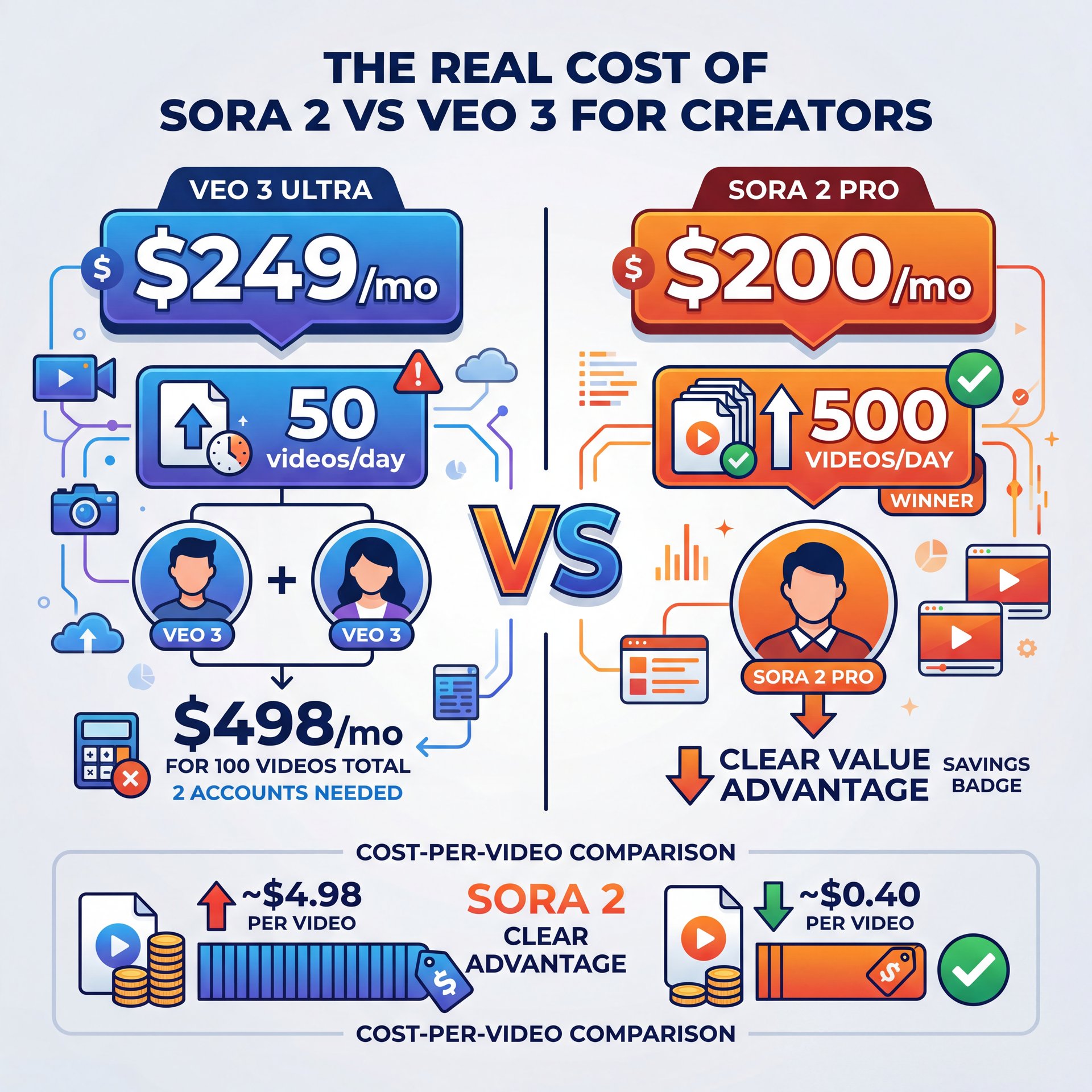
Veo 3 Ultra is sitting at $249 a month. If you need volume, you might need two accounts because of that daily cap I mentioned earlier. Consider video the north star of this approach. That puts you at basically $498 a month for 100 videos just for the software if you’re maxing it out.
Sora 2 Pro is estimated around $200 a month, but you get a 500-video capacity. that is a massive difference in cost-per-video.
(Spoiler alert.)
**Veo 3 Ultra**
$249/mo
- ✓ Best for high-end commercials where you need 4K resolution and specific textures.
**Sora 2 Pro**
~$200/mo
- ✓ Best for volume content, social media clips and physics-heavy scenes.
**Hybrid Setup**
~$450/mo
- ✓ The pro choice. Use Sora 2 for bulk and Veo 3 for hero shots.
Hidden Costs Nobody Mentions
If you’re, a casual user, Veo 3 is probably overkill. The credit burn rate is high because of the regeneration needs for audio. If you have to regenerate a clip 3 times to get the sound right, you just tripled the cost of that clip.
Pro Tip: Always calculate your “Cost Per Usable Second.” If Veo 3 costs about $0 per second generated but you throw away 50% of it, your real cost is roughly $1 per second. Sora 2’s lower waste rate often makes it cheaper in the long run.
(Bear with me for a second.)
Need Thumbnails for Your Videos?
While you’re generating all this video content, don’t forget you need to package it. Banana Thumbnail helps you create click-worthy thumbnails that actually get people to watch these AI masterpieces you’re building.
Sora 2 vs Veo 3 Trends to Watch in 2026
So where is this all going? I’m looking at the roadmaps for late 2025 and early 2026 and the area is shifting.
Google is pushing hard on integration. They want Veo 3 to live inside YouTube and Google Workspace — and imagine opening your Google Doc and generating a video clip right THERE. That’s the play. Period. By 2026, we expect deeper integration where Veo 3 can pull assets directly from your Drive.
OpenAI seems to be focusing on the enterprise API for Sora 2, and they want big platforms to build on top of them. This means we might see better third-party tools that use Sora 2’s engine but with a better interface.
Also, keep an eye on the physics updates. Veo 3.1 is already trying to close the gap with Sora 2 on fluid dynamics. Competition is honestly impressive for us. it keeps prices in check and forces them to fix these bugs.
2026 Readiness Checklist
- [ ] Budget: Allocate $300-$500/mo for AI video tools.
- [ ] Hardware: Ensure you have local storage for 4K files (cloud costs add up).
- [ ] Skills: Learn basic sound design; AI audio isn’t ready to take over yet.
- [ ] Platform: Check Banana Thumbnail pricing to simplify your publishing workflow.
In the end, niether of these tools is a magic button. they’re power tools. You still need to know how to build the house. But if you pick the right one for the specific job, Sora 2 for motion, Veo 3 for looks. That’s it. you can get some solid results.
Frequently Asked Questions
What are the main differences in user experience between Veo 3 and Sora 2?
Veo 3 feels more like a studio tool with complex settings and high fidelity. Sora 2 is faster and more intuitive for generating longer, fluid clips with less fuss.
How do Veo 3 and Sora 2 perform for video quality and realism?
Veo 3 wins on static texture and resolution (up to 4K), making it look more “photorealistic,” but Sora 2 wins on movement realism and physics, making the action feel more natural. Period.
What are the key advantages of Veo 3’s native audio synthesis?
Veo 3 can generate synchronized dialogue and sound effects directly within the tool, saving you from using external audio software, though it often requires multiple attempts to get right.
What are the main differences in user experience between Veo 3 and Sora 2?
Veo 3 feels more like a studio tool with complex settings and high fidelity. Sora 2 is faster and more intuitive for generating longer, fluid clips with less fuss.
How do Veo 3 and Sora 2 perform for video quality and realism?
Veo 3 wins on static texture and resolution (up to 4K), making it look more “photorealistic,” but Sora 2 wins on movement realism and physics, making the action feel more natural. Period.
What are the key advantages of Veo 3’s native audio synthesis?
Veo 3 can generate synchronized dialogue and sound effects directly within the tool, saving you from using external audio software, though it often requires multiple attempts to get right.
Quick Tips:
- Use Sora 2 for any scene involving water, fire or crashing objects.
- Use Veo 3 for close-up shots of faces or static products.
- Always budget for 2-3 regenerations when using Veo 3’s audio features.
Related Videos



Related Content
• sora
For more on this topic, check out: sora
Listen to This Article