

Table of Contents
- What Are Flux AI Prompts and Why Do They Matter?
- How to Build High-Quality Flux AI Prompts Fast (the boring but important bit)
- Why Do My Flux AI Prompts Look Muddy?
- Best Flux AI Prompts for Photorealism vs. Stylized Art
- Advanced Flux AI Prompts: Using the Pro API in 2025
- Flux AI Prompts vs. Midjourney – Which Is Faster?
- Listen to This Article
All right, let’s get straight to it. There’s this massive myth floating around that getting PROFESSIONAL-GRADE AI images takes hours of tweaking, sweating over keyboards, and praying to the algorithm gods. Consider Craft the GPS here — it tells you where to go. Every time. Honestly? That’s just not true anymore, especially with flux ai prompts.
So today we’re going over how you can craft killer Flux AI Prompts in under 15 minutes. And I’m not talking about basic “dog on a skateboard” stuff. I mean high-fidelity, production-ready assets that actually look professional.
Here’s the thing—most people treat prompting like a slot machine. They pull the handle, hope for the best and get frustrated when the result looks weird. But if you have a system with flux ai prompts, it’s more like a vending machine. You punch in the right code, you get exactly what you paid for.
We’re seeing Flux AI by Black Forest Labs delivering inference speeds that are like 12x faster than older models—we’re talking 1 to 4 seconds per image. That speed changes everything. It means we can iterate fast with flux ai prompts. Every time. But speed doesn’t matter if your prompt is broken from the start.
So let’s go under the hood and fix your workflow.
What Are Flux AI Prompts and Why Do They Matter?
(Plot twist.)
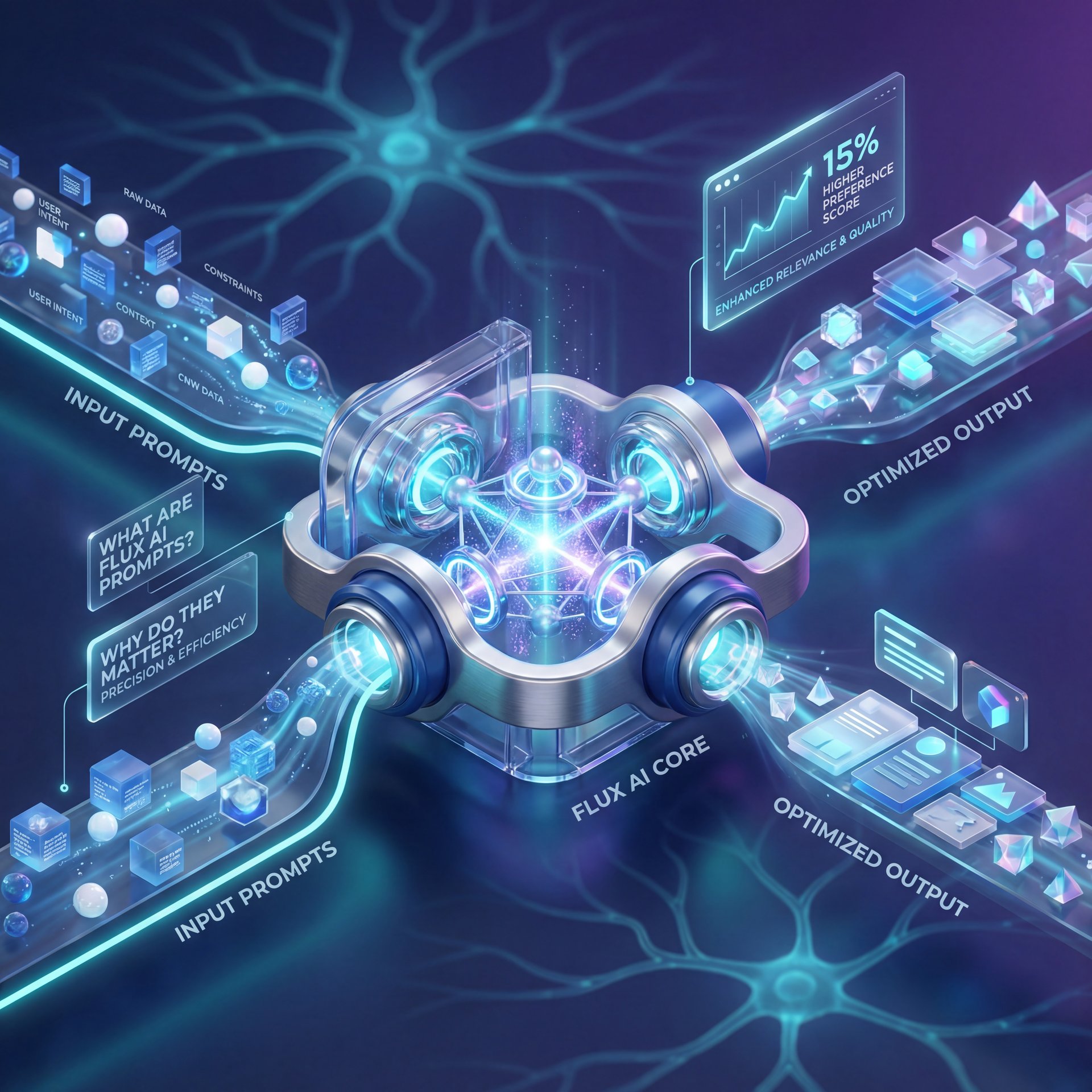
First off, it helps to know what we’re actually working with here when crafting flux ai prompts. Flux isn’t just another image generator. It’s built on a 12-billion parameter architecture that specifically targets human preference. In fact, data shows it hits about 15% higher human preference scores than its main competitors.
But why should you care about Flux AI Prompts specifically? Well, in 2025, the game has changed. We aren’t just typing words anymore; we’re directing a model that understands nuance. The problem is, most folks are still using 2023 tactics. Trust me on this. They stuff keywords in a blender and hope it works.
(We’ve all been there.)
When you get the prompt right, the ROI is massive. Companies are reporting about 4x return for every dollar they put into generative AI technologies like this. That’s real money. Whether you’re a casual user just trying to make a cool profile pic, or a pro building assets for a campaign, flux ai prompts are your control panel. If you ignore the structure, you get chaos. If you use the right structure, you get magic.
(You get it.)
Also, prompt design remains the dominant customization technique in over 50% of AI deployments. So this isn’t some niche skill (it’s quickly becoming needed for anyone working with generative tools. It’s like the alternator — design keeps everything charged.
How to Build High-Quality Flux AI Prompts Fast (the boring but important bit)
Now, here’s the meat and potatoes. How do we actually do this in under 15 minutes?
My favorite approach (and the one that works best for Flux, is the RTF structure. That stands for Role, Task, Format — Okay, maybe not exactly —. It sounds simple, but it stops you from staring at a blank screen. The average prompt creation time using this method? About 12 minutes.
The Role (Who is the AI?)
First, tell the AI who it’s. Is it a professional photographer? A 3D render artist? A charcoal sketcher? For example: “You are an award-winning architectural photographer.” This sets the perspective and style instantly.
The Task (What is the scene?)
Next, describe the scene. This is where you need to be specific but not wordy, which means “Capture a modern living room with floor-to-ceiling windows during golden hour.” Keep it clear & visual.
The Format (Technical specs)
Finally, the technical stuff. Pay attention to this for Flux. Picture this: Craft is the canvas, everything else is paint. You wanna specify things like “8k resolution,” “cinematic lighting,” or “shot on 35mm.” These details tell Flux exactly what quality level you’re aiming for.
When you combine these, you get a structured prompt that Flux understands straight away. You don’t need to spend 45 minutes guessing. You spend 2 minutes building the RTF and the rest of the time refining.
📋 RTF Cheat Sheet (seriously)
Use this template to save time:
Role: [Adjective] [Profession] (e.g., “Expert Food Photographer”)
Task: [Action] [Subject] in [Setting] (e.g., “Capturing a steaming burger in a diner”)
Format: [Lighting], [Camera Angle], [Style] (e.g., “Soft box lighting, macro shot, 4k”)
If you’re finding that your images are good but need a little extra polish after generation, you might want to check out our guide on fixing Nano Banana Pro prompts to handle the editing side of things.
Why Do My Flux AI Prompts Look Muddy?
(Bold claim, I realize.)
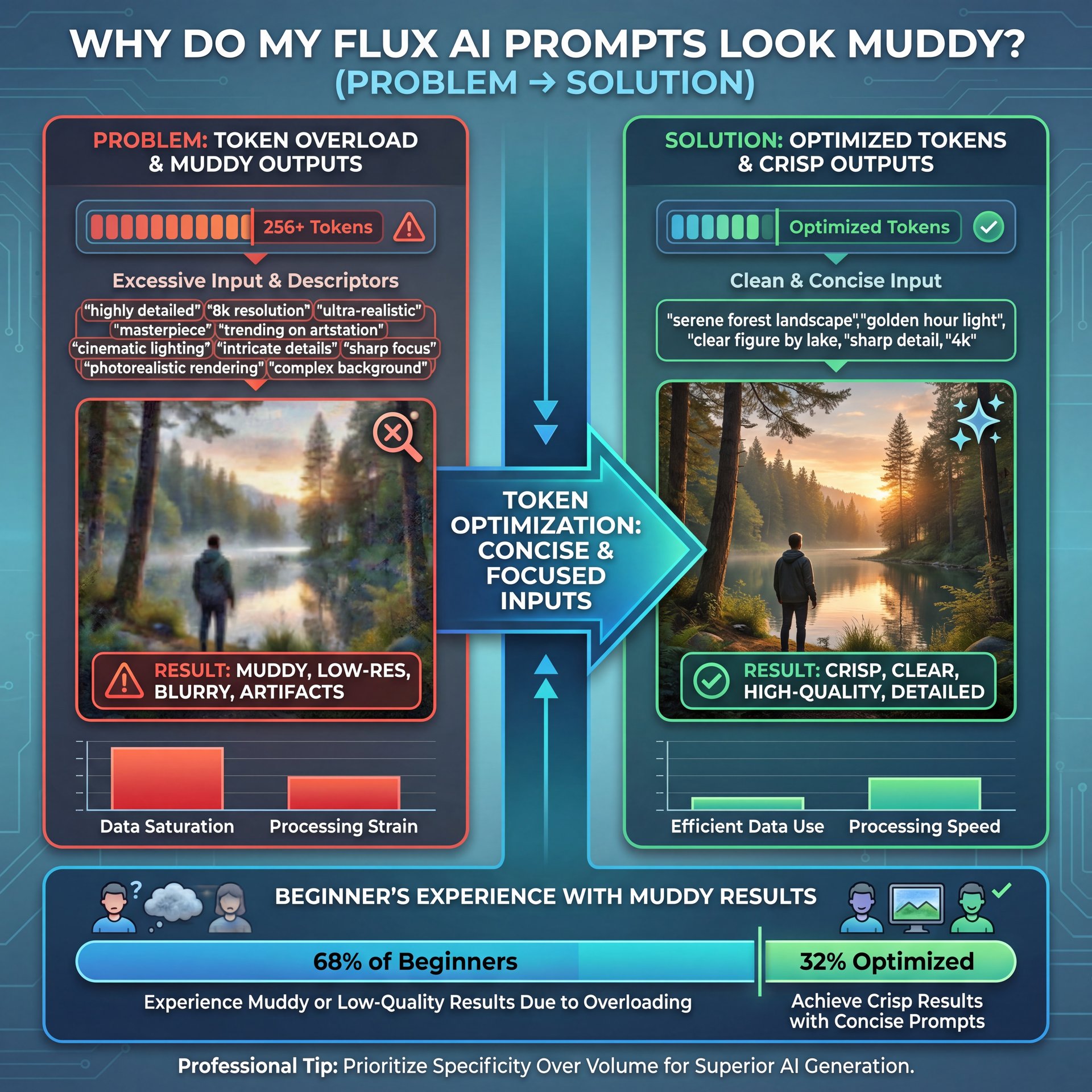
So you tried the structure, but your images still look kinda… soup-like? You’re not alone. About 68% of beginners report getting muddy or low-resolution images. Usually, this comes down to one of two things: generic inputs or token overload.
Let’s talk about tokens. A “token” is basically a chunk of text the AI reads. Flux has a limit. While it can technically handle 256 tokens, the quality starts to tank if you push it too hard.
Here’s what I’ve found: if you go over 75 tokens, the model struggles to pay attention to everything. In fact, 61% of intermediate users struggle with multi-subject coherence, yielding 45% artifact rates on prompts over 75 tokens. No, really.. It’s like trying to listen to three people talking at once. you miss the details.
Fidelity drops 22% beyond the 75-token threshold according to professional benchmarks. . Black Forest Labs Documentation
So, keep it tight. Cut the fluff. You don’t need to say “a really, really, very beautiful solid sunset.” just say “lively sunset.”
Also, use negative prompts. These are the things you don’t want. If you don’t tell Flux to avoid “blurry” or “deformed,” it might just throw them in there. Here’s the kicker: 82% of users cite hallucinations in anatomy and details without negative prompts. But adding a simple negative prompt string like “blurry, deformed, extra limbs:1.4, lowres” can reduce artifacts by 65%. Period. Worth it. That’s a huge fix for five seconds of typing.
Best Flux AI Prompts for Photorealism vs. Stylized Art
Now, depending on what you’re doing, your Flux AI Prompts need to shift gears. The approach for photorealism is completely different from stylized art.
Prompting for Photorealism
If you want photorealism. like for a fashion editorial, you need to speak the language of a camera. Use terms like “depth of field,” “f/1.8,” “shutter speed,” and “ISO 100.” I was messing around with this the other day and simply adding “shot on Sony A7R IV” completely changed the skin texture of a portrait. It went from looking like plastic to looking like a real person.
(But I’m getting ahead of myself.)
Prompting for Stylized Art
On the flip side, if you want stylized art, you need to reference styles and mediums. “Oil painting,” “thick brushstrokes,” “matte painting,” or “Unreal Engine five render” all push the output in different artistic directions. Riley Santos, a creative storyteller I follow, always emphasizes that the story dictates the style. If you’re telling a gritty story, use gritty prompt words. Every time. Don’t just ask for “pretty.”
And here’s, a tip: You can use tools like Copilot to help generate these variations. I often ask Copilot, “Give me 5 variations of a prompt for a cyberpunk city, ranging from photorealistic to anime style.” it saves me so much brain power.
🔧 Use Copilot for Variations – and why it matters
Stuck on a prompt? Ask Copilot to “rewrite this prompt for better lighting” or “convert this to a 3D render style.” It acts like a creative partner to speed up your process.
If you’re looking to take these static images and turn them into motion, we actually covered that in our Google Veo 3.1 guide, which pairs perfectly with high-quality Flux outputs.
Advanced Flux AI Prompts: Using the Pro API in 2025
Now, if you’re in the professional crowd, that 25% of you who do this for a living, we need to talk about the 2025 updates. The Flux.1 Pro API released in December 2025 introduced tool-calling features. This is big. It means we’re moving toward “agentic AI.”
Basically, instead of just making a picture, the AI can plan, execute, and check its work. It’s like having a mini-employee inside the computer. Global generative AI enterprise spending reached $37 billion in 2025, up 3.2x from $11.5 billion in 2024. Simple as that. Game changer. Why? Because it works.
For us, this means we can chain prompts. You can have one prompt generate, the background, another generate the character and a third blend them together. It’s a bit more technical, but if you’re facing those “hallucination” issues, where the AI makes up weird anatomy, this step-by-step approach fixes a lot of it.
You don’t need to be a coder to think like one. Break your big image idea into smaller pieces. Prompt for the background first. Then prompt for the subject. It takes a few minutes more, but it saves you hours of fixing bad hands in Photoshop later.
Flux AI Prompts vs. Midjourney – Which Is Faster?
I get asked this all the time: “Why bother with Flux when Midjourney exists?” Look, I love Midjourney. But here’s the thing about Flux (it’s fast). Like, really fast.
Midjourney can take a minute or more to generate a grid. Flux is hitting that 1-4 second mark per image. Game changer. If you’re iterating (trying to find the perfect angle for a thumbnal or a product shot, that speed difference adds up.
Plus, cost. Platforms like Fal.ai are offering extremely competitive rates, something like $0.06 for a batch of images. If you’re running a business, those pennies count.
Midjourney still has a slight edge on artistic “vibes” out of the box. Flux is more literal. It does exactly what you tell it. That’s why your Flux AI Prompts need to be precise. Midjourney guesses your intent; Flux obeys your commands.
So, if you want total control and speed, go Flux. If you want happy accidents, go Midjourney. Personally, I prefer the control.
⚠️ Don’t Ignore Local Setup
Many users pay for cloud hosting when they have a powerful GPU at home. ComfyUI allows for free local generation with Flux, though setup takes about 10 minutes.
🤔 Did You Know?
82% of users cite hallucinations in anatomy without negative prompts. Adding a simple negative string reduces these artifacts by 65%.
So, that’s the rundown. You don’t need to spend all day on this. Use the RTF structure, watch your token count and take advantage of the speed of Flux. With a little practice, you’ll be cranking out professional results in 15 minutes or less.
Frequently Asked Questions
What are the most common challenges users face when creating AI prompts?
Most users struggle with vague outputs due to generic phrasing or “muddy” images caused by using too many tokens (over 75). Every time. Hallucinations, like extra fingers, are also common if negative prompts aren’t used.
How has the adoption of generative AI changed over the past year?
Adoption has skyrocketed, with enterprise spending hitting $37 billion in 2025, a 3.2x increase from $11.5 billion in 2024. More companies are moving from just experimenting to integrating these tools into daily workflows.
What are the latest trends in AI prompt engineering for 2025?
The biggest trend is “agentic AI,” where prompts are part of a larger workflow that includes planning and tool use. We’re also seeing a shift toward shorter, structured prompts like the RTF structure to save time.
Can you provide examples of successful AI prompt engineering projects?
Black Forest Labs themselves used structured prompting and distillation to make Flux.1-schnell 12x faster than competitors. Think of it like cooking — workflow is your secret ingredient. Also, marketing firms are using these workflows to cut asset creation time by over 50%.
What are the key differences between fine-tuning and prompt engineering?
Prompt engineering is about guiding the model with words and is much faster and cheaper (used in over 50% of deployments).Fine-tuning involves retraining the model on new data. No joke. It Is useful but costly & technical.
What are the most common challenges users face when creating AI prompts?
Most users struggle with vague outputs due to generic phrasing or “muddy” images caused by using too many tokens (over 75). Every time. Hallucinations, like extra fingers, are also common if negative prompts aren’t used.
How has the adoption of generative AI changed over the past year?
Adoption has skyrocketed, with enterprise spending hitting $37 billion in 2025, a 3.2x increase from $11.5 billion in 2024. More companies are moving from just experimenting to integrating these tools into daily workflows.
What are the latest trends in AI prompt engineering for 2025?
The biggest trend is “agentic AI,” where prompts are part of a larger workflow that includes planning and tool use. We’re also seeing a shift toward shorter, structured prompts like the RTF structure to save time.
Can you provide examples of successful AI prompt engineering projects?
Black Forest Labs themselves used structured prompting and distillation to make Flux.1-schnell 12x faster than competitors. Think of it like cooking — workflow is your secret ingredient. Also, marketing firms are using these workflows to cut asset creation time by over 50%.
What are the key differences between fine-tuning and prompt engineering?
Prompt engineering is about guiding the model with words and is much faster and cheaper (used in over 50% of deployments).Fine-tuning involves retraining the model on new data. No joke. It Is useful but costly & technical.
Related Videos

Related Content
• prompts
• flux
For more on this topic, check out: flux
Listen to This Article