
Table of Contents
- What Is a Free AI Art Generator Actually Doing? (seriously)
- Which Free AI Art Generator Works Best for Thumbnails?
- How to Avoid the Most Common Free AI Art Generator Problems (the boring but important bit)
- Why Use a Free AI Art Generator for Your Channel Growth?
- How Do You Get the Best Results from These Tools?
- Free AI Art Generator vs Paid: Is It Worth the Upgrade?
- Listen to This Article
All right, so let’s get into this.
I was talking to Alex Rivera, our Senior Content Analyst, the other day. He told me about this time he spent three hours trying to draw, a simple background for a video about changing oil filters. Three hours. He finally gave up, used a free AI tool and had exactly what he needed in four seconds. That really struck me. It’s like spending all afternoon trying to loosen a rusted bolt by hand when you have an impact wrench sitting right there in the drawer.Today we’re gonna go over the best free AI art generators you can use right now. This Means and here’s the thing—I know a lot of you’re worried about cost. Consider thumbnail the integration point. You wanna make great thumbnails, but you don’t want to spend a fortune on subscriptions. I get it. So we’re going to look at tools that actually work without breaking the bank.
The numbers back this up too. The Global AI in Art and Creativity Market was valued at USD 16.23 billion in 2025 and it’s projected to reach USD 161.11 billion by 2034 at a close to 26% CAGR according to recent market reports. Visual art and image generation applications, including the rise of the free ai art generator, dominate with roughly 62% of the AI art market share. This isn’t just hype—this is real technology that’s changing how we work.
What Is a Free AI Art Generator Actually Doing? (seriously)
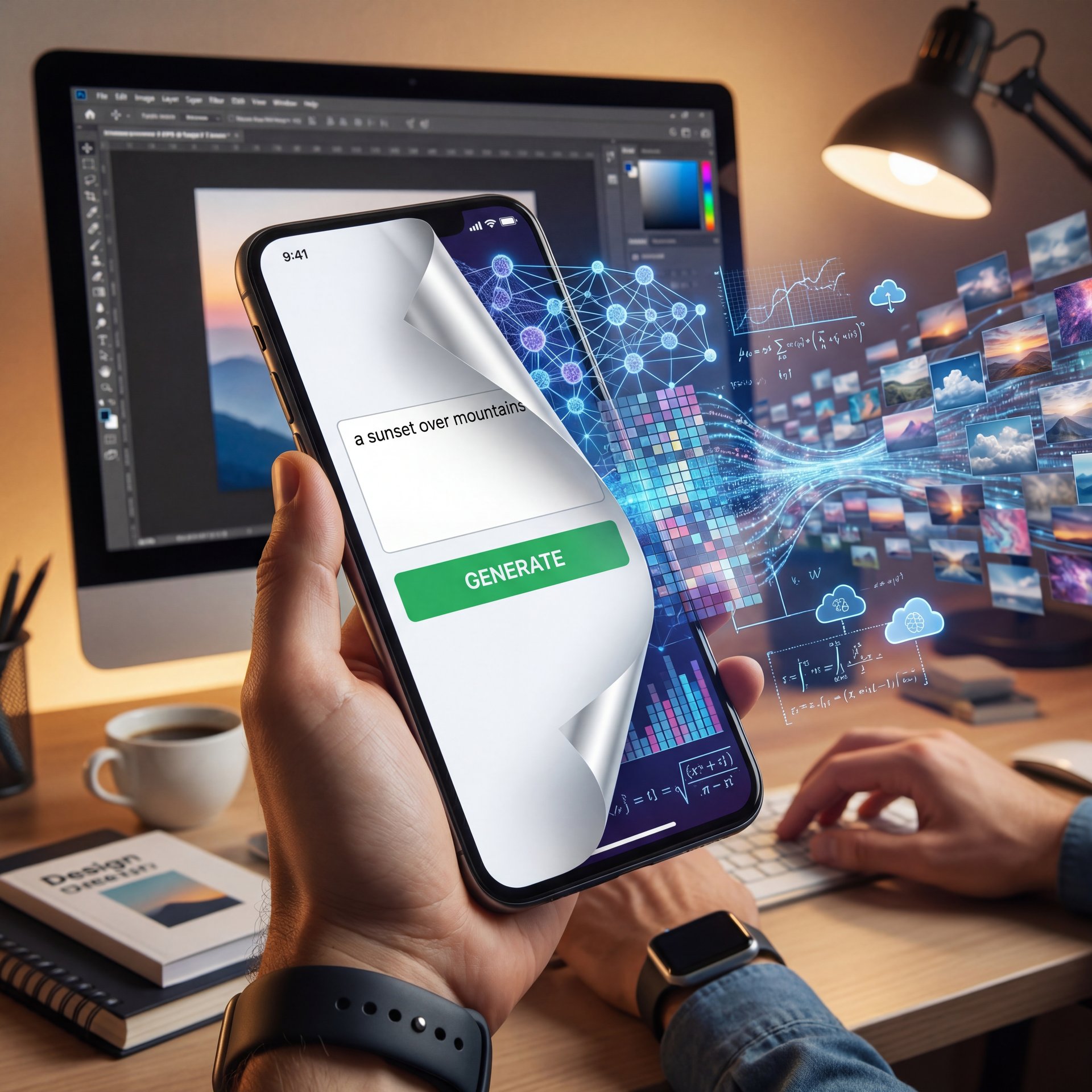
So, first thing you want to know is what’s happening under the hood, and when you type a prompt into these tools, you aren’t just searching for an image. You’re telling a computer to build a picture pixel by pixel based on millions of examples it has seen before.
Now, in 2026, this tech has moved fast. I mean, really snappy. We’re seeing cloud-based tools, which make up about around 83% of the market now, that can run on your phone. You don’t need a massive gaming PC anymore to access a free ai art generator. Plus, mobile-first generators are growing at 15.4% in 2026, which means you can literally create professional thumbnails. Sitting in your truck on a lunch break.
But here is what consider watch out for. tool is measurable impact. A lot of these tools promise the world but deliver vague, blurry messes. In fact, 68% of beginners say they get vague results because the free ai art generator just doesn’t understand what they want. It’s frustrating. Big difference. It’s like telling a mechanic “my car makes a noise” and expecting them to know exactly which part to replace without looking at it.
The technology behind these tools varies. Some use diffusion models, which gradually refine an image from noise. Others, like OpenAI’s GPT-4o, acheive 95% prompt adherence for photorealistic thumbnails, surpassing traditional diffusion models and most free ai art generator options. Means that means when you ask for something specific, you’re way more likely to get it.
⭐ Creator Spotlight: TikTok Wizard Uses Free AI Art Generator
I saw this creator, @ThumbnailWizard on TikTok, who started using Craiyon’s free API for batch thumbnails. They didn’t just make one or two; they automated a whole bunch. The result? They grew their followers by 312K in late 2025. If you want to see how automation can help your channel, check out our video generation features.
Which Free AI Art Generator Works Best for Thumbnails?
(Supposedly.)
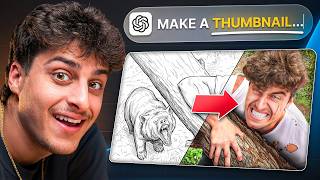
I’ve been designing YouTube thumbnails for years and I’ve worked with some of the biggest creators on the platform and I can confidently say AI has completely changed how I design thumbnails. Wild, right? In this video, I’m going to show you the exact workflow I use to create high-erforming thumbnails faster and easier than ever before using what’s essentially a free ai art generator approach. I’m going to walk you through all the tools I use on real client projects. And I’ve never broken it down as simple as this. By the end of this video, you’ll be able to copy my exact process to create better thumbnails faster than ever. And by the way, the thumbnail you clicked on in this video is the one we’re going to be creating together live. So, if you want more thumbnail education videos like this, then subscribe. Now, we are only going to be using three tools: ChatGBT, Freepick and Photoshop. Let’s first start with ChatGBT and build the concept for this thumbnail. Once inside chat GBT, go ahead and add in reference images of yourself or your client. Worth it. Simply come to the plus, click add photos and I’m going to add in three photos that are found on my YouTube channel.
Canva Magic Studio (seriously)
(Controversial opinion incoming.)
I use this one a lot. It’s fast (about 4 seconds to generate an image). What I like is that it fits right into the design workflow — and you generate the image, and then you can snap it right into a 1280×720 layout. It solves that problem where 74% of users complain about watermarks or weird aspect ratios.
Canva also gives you the full editing suite right there, so you can tweak colors, add text and export without jumping between three different programs. For someone who just wants to get the job done, this is gold.
Bing Creator (DALL-E 3)
This one is solid. It uses DALL-E 3 and it’s great for following instructions. If you say “put a red car on the left,” it actually puts a red car on the left. It takes a bit longer, maybe 15 seconds, but the quality is high.
What I found interesting is that DALL-E understands context better than most other tools. If you mention “workshop setting” or “sunset lighting,” it incorporates those details naturally. Still, you’re limited on how many images you can generate per day, so plan so.
Midjourney
Now, here’s the thing about Midjourney. It used to be strictly paid, but lately, I’ve seen them offering limited free generations (around 25 GPU minutes a month in some tiers). The quality? Solid. Marques Brownlee scaled 500+ monthly thumbnails using Midjourney free tier, cutting creation time by 87% and boosting CTR by 23% to around 9% average for 1.2 million additional views monthly. That’s huge.
The artistic style you get from Midjourney is different too. It tends toward a more polished, almost cinematic look that really pops in a crowded YouTube feed. If you want your thumbnails to stand out, this is a strong choice.
Stable Diffusion (seriously)
This is for the tinkerers. If you like to get your hands dirty and adjust every little setting, this is your tool. It’s open-source, and while it might take 18 seconds to generate, you have total control.
(…probably.)
The advantage here is customization. You can install different models, adjust sampling methods, and even train it on your own style. But that also means there’s a learning curve. Trust me on this. If you’re comfortable with tech and want maximum flexibility, Stable Diffusion delivers.
Craiyon, NightCafe and Fotor
Craiyon is a bit slower but offers unlimited tries. That’s helpful when you’re experimenting and don’t want to burn through your daily limit. NightCafe is cool because it supports GIFs, which is neat for social media. And Fotor? It’s really good on mobile, which makes sense given that mobile-first tools are growing so fast.
Each of these has quirks. Craiyon sometimes produces lower resolution images, but you can run it as many times as you want.NightCafe has, a community aspect where you can see what others are creating. This Is great for inspiration. Not even close. Fotor is straightforward and quick, perfect if you’re on the go.
Pro Tip: If you’re getting bad results, try describing the lighting. Instead of “a car,” try “a car in a garage with overhead fluorescent lighting.” It makes a chunky difference.
How to Avoid the Most Common Free AI Art Generator Problems (the boring but important bit)
So, let’s cover the problems. Because honestly, these tools aren’t perfect.
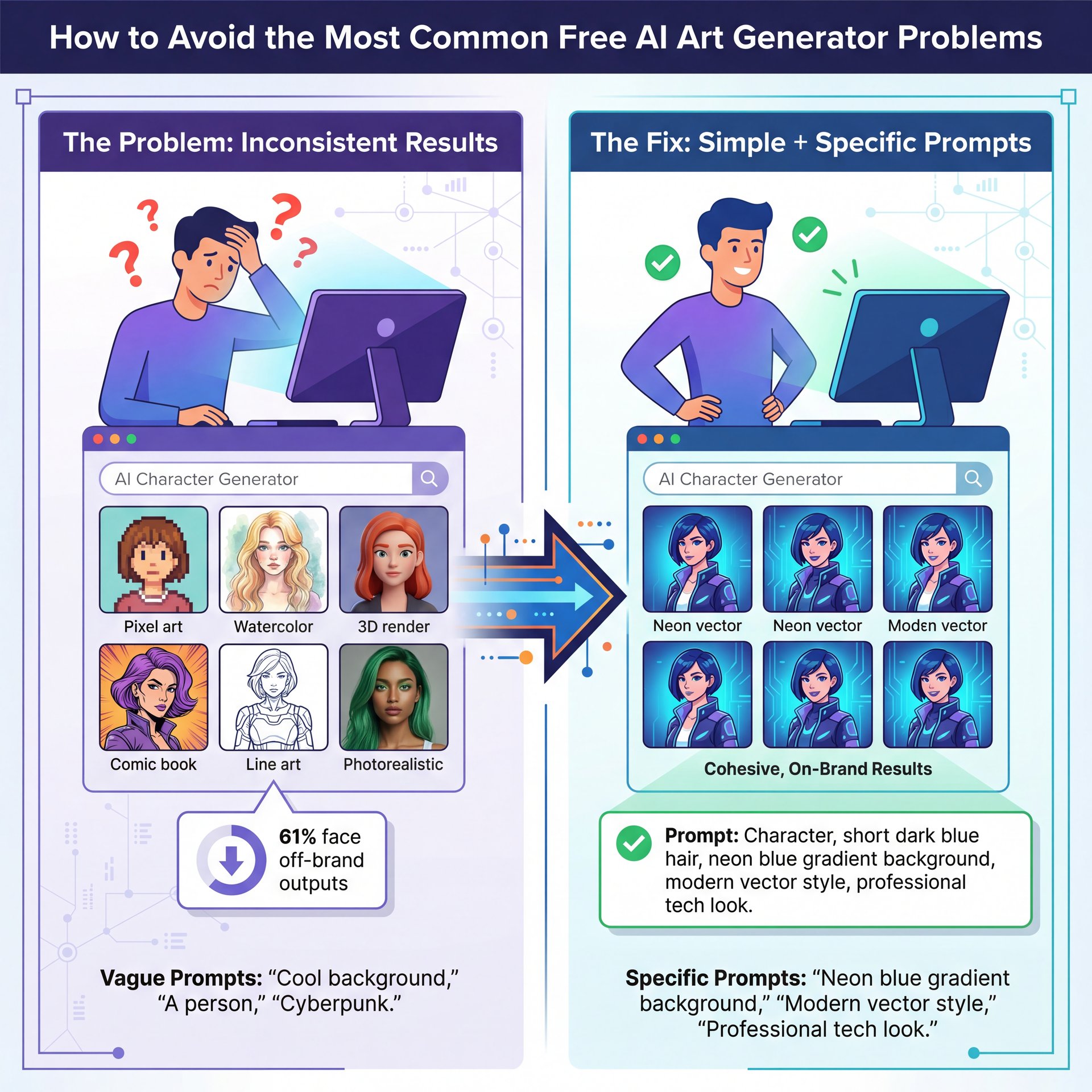
One big issue is consistency. You generate a character, and in the next image, they look like a completely different person. It happens. Professionals struggle with this too (about 61% face off-brand outputs), which means that’s a real pain when you’re trying to build a recognizable style for your channel.
To fix this, keep your prompts simple but specific. Don’t just say “cool background.” say “neon blue gradient background with smoke effects.” The more concrete details you provide, the more consistent your results will be.
Resolution and Upscaling
Another thing is resolution. A lot of free tiers cap you at 1024×1024 pixels. That’s fine for Instagram, but for a 4K YouTube video? It might look soft. Seriously.. You’ll want to upscale it using a seperate tool or by upgrading to a paid tier.
Some tools let you generate at higher resolutions if you tweak the settings. With Stable Diffusion, for example, you can manually set the output size, though it takes longer to process.
Style Consistency
Getting the style right takes practice. If you’re struggling, I wrote a whole guide on fixing ChatGPT image thumbnails that covers SIMILAR prompt issues. Big difference. The key is iteration. don’t expect perfection on the first try.
Also, save your prompts. When you find something that works, copy it into a document so you can reuse it or modify it slightly for future thumbnails. Huge. This builds your own personal libary of what works.
Visual art & image generation applications dominate with close to 62% of the AI art market share, reducing thumbnail creation time from 45 minutes to 3 minutes. ( Market).us Report
Why Use a Free AI Art Generator for Your Channel Growth?
Now, you might be thinking, “Why bother with AI? I can just draw it.”
And sure, you can. But let’s talk about time. The market data shows that using these tools can cut your work time by 93%, reducing thumbnail creation time from 45 minutes to 3 minutes. That’s the difference between spending nearly an hour on a single thumbnail and knocking it out during a commercial break.
If you’re running a channel, that time adds up. You could be using those saved hours to film more videos, engage with your audience, or fix that leak in the garage. Bottom line. Plus, better thumbnails mean more clicks. We’ve seen click-through rates jump by 23% when the thumbnails are on point. That translates directly to more views and more growth.
It’s not just about being lazy. It’s about being smart with your time. In fact, 72% of global companies use AI in at least one business function, boosting ROI by 2.3x in content production efficiency. Worth noting. You’re not cutting corners. you’re using the same tools the pros use.
How Do You Get the Best Results from These Tools?
All right, so here’s what you want to do if you want the best images.
Check Your Settings
First, make sure you’re asking for the right size. If you need a YouTube thumbnail, ask for a 16:9 aspect ratio. If the free tool only gives you squares, be ready to grabbed a tool like Canva to extend the background. Game changer. Some generators let you specify exact dimensions in the prompt, so read the documentation or help section.
Also, pay attention to the quality settings. Some tools have options for speed versus quality. If you’re just testing ideas, speed is fine. But for the final version, always go with the highest quality setting available.
Iterate and Experiment
Don’t just take the first result. I usually run the prompt three or four times. Sometimes the second or third try is the winner. It’s like diagnosing a rattle. you might not find it on the first test drive.
Experimentation is part of the process. Try different words, different styles and different compositions. What surprised me was how much a small word change could completely shift the output. Saying “dramatic lighting” versus “soft lighting” can give you totally different vibes.
Combine Tools for Maximum Impact (bear with me here)
I like to generate the main image in Midjourney or DALL-E and then bring it into Canva to add text. AI is surprisingly good at pictures, but it’s still pretty bad at spelling. You don’t want a killer image ruined by garbled text that looks like a toddler typed it.
Combining tools also lets you layer effects. Generate, a background in one tool, a character in another and then composite them in Canva or Photoshop. This gives you more control and helps you build a unique style that stands out.
For more on picking the right generator, check out our breakdown of the best AI image generators for 2026.
(Bold claim, I realize.)
📊 Before/After: The Efficiency Jump – quick version
Before using AI, a typical pro creator spent 45 minutes on a single thumbnail design. After switching to tools like Canva Magic Studio, that dropped to 3 minutes. That’s a 93% time saving you can use to make more content. Want to speed up your workflow? Check out our workflow guides.
Free AI Art Generator vs Paid: Is It Worth the Upgrade?
So from there, you need to know: when should you actually pay?
Honestly, for most people starting out, the free tools are enough. You can get great results with Bing Creator or the free tier of Canva. If you’re making a few thumbnails a week and you’re happy with the quality, there’s no reason to upgrade yet.
(Probably. Usually.)
But if you’re doing this professionally, the paid tiers usually give you faster generation times & better privacy. About 39% of professionals worry about copyright issues with free tools. If you’re working for big clients, paying for a private mode might be worth the peace of mind. You also get access to more styles, higher resolutions, and priority processing so you’re not waiting around.
Another consideration is volume. If you’re generating hundreds of images a month like Marques Brownlee, the paid tiers make sense because they remove daily limits. Worth it. But yeah, for your personal channel or a side project? Stick to the free stuff until you hit a wall.
The upgrade is worth it when time becomes more valuable than money, or when you need features that the free versions just don’t offer. Until then, squeeze every bit of value out of the free tiers.
Thanks for reading guys. If you think this was helpful, be sure to check out the tools and see what works for you. That should fix your thumbnail problems if you have these symptoms.
Frequently Asked Questions
What are the most popular AI art generators among professionals?
Professionals heavily favor Midjourney and Stable Diffusion because they offer the most control over the final image details. About around 43% of professional creators use these tools for fast prototyping and high-quality output.
How do AI art generators compare about user-friendliness?
Canva and Bing Creator are generally the easiest for beginners since they handle a lot of the technical settings for you. Tools like Stable Diffusion require a bit more technical know-how to get running properly.
What are the main challenges users face when using AI art generators?
The biggest headaches are usually vague results from poor prompts and dealing with watermarks on free versions. Many users also struggle with getting consistent characters across different images.
What are the most popular AI art generators among professionals?
Professionals heavily favor Midjourney and Stable Diffusion because they offer the most control over the final image details. About around 43% of professional creators use these tools for fast prototyping and high-quality output.
How do AI art generators compare about user-friendliness?
Canva and Bing Creator are generally the easiest for beginners since they handle a lot of the technical settings for you. Tools like Stable Diffusion require a bit more technical know-how to get running properly.
What are the main challenges users face when using AI art generators?
The biggest headaches are usually vague results from poor prompts and dealing with watermarks on free versions. Many users also struggle with getting consistent characters across different images.
Related Videos
Related Content
For more on this topic, check out: 7 Free AI Art Generators: Create Thumbnails Fast
Listen to This Article