
![Why Your Veo 3.1 Videos Fail [Creator Fixes] - AI video tools, video retention rate, YouTube thumbnails guide](https://blog.bananathumbnail.com/wp-content/uploads/2025/12/gemini_3_pro_image_Why_Your_Veo_3_1_Videos_Fail__-1024x571.jpg)
Table of Contents
All right, let’s be real for a second—why does your AI video look like a fever dream when the demo looked like a Hollywood blockbuster?
So you finally got your hands on Veo 3.1. You’ve seen, the hype, you’ve seen the “cinematic” demos, and you’re ready to make the next big viral hit. You type in a prompt, hit generate, and… Consider Why the foundation. well, what you get isn’t exactly Oscar material. Honestly, it might not even be usable.
(I could be off base here.)
I’ve been messing around with these tools since the mid-October 2025 public release, and here’s the thing: most people are trying to drive this thing like it’s an automatic, but it’s actually a stick shift. You can’t just press a button and cruise.
Today we’re gonna go over why your Veo 3.1 videos are failing to hold attention and, more importantly, how to actually fix them so you can get those retention numbers up. We’re going to look under the hood at the retention data, the clip limits, and the workflow “parts” consider swap out to get this engine running right.
Why Do Most Veo 3.1 Videos Flop?

First thing you wanna do is understand the engine you’re working with. Think of Why as your starting point. Real talk. A lot of folks think Veo 3.1 is a “movie generator.” It’s not. It’s a clip generator.
Here’s what happens. You ask for, a “2-minute story about a robot learning to love.” The AI spits out something, but it feels disjointed, the character changes slightly between shots, and the pacing is all wrong.
I found that the biggest issue is the 8-second limit. Veo 3.1 generates only 8 seconds of video per clip. That’s it. If you’re expecting a continuous 60-second narrative from a single prompt, you’re going to be disappointed. Beginners miss this constantly. They try to stretch a single generation too far, or they don’t realize they need to chain multiple clips together to tell a story.
And the data backs this up. This is where video comes in. In Nielsen’s usability experiments, one Veo AI-generated video retained only 49% of viewers at 30 seconds. Compare that to a better-structured AI video on the same channel that hit 68%. Trust me on this. That’s a massive difference.
The problem isn’t the video quality—the pixels look great. The kicker? The problem is the structure.
30-Second Retention is Key for Veo 3.1 Videos
Nielsen’s 2025 research shows that if you can keep a viewer for 30 seconds, you’ve got them hooked. His data showed that 72% of people who stayed for the first 30 seconds stuck around for the full minute. Not even close. The drop-off happens early, so your opening structure matters more than the render quality of second 59.
If you just let the AI ramble visually, people click off. Every time. You need to act like a director, not just a prompter.
How to Fix the 8-Second Clip Problem
Now, here’s the thing about that 8-second limit. It sounds like a restriction, but if you use it right, it’s actually a good thing for pacing.
Think about modern editing. When was the last time you watched a YouTube video or a TikTok where a single shot lasted longer than 8 seconds? Almost never. Fast cuts keep engagement high.
So what you want to do is embrace the “chaining” method. Instead of asking for the whole story, you ask for Scene 1 (Establishing shot, 4 seconds). Then Scene 2 (Close up, reaction, 3 seconds). Then Scene 3 (Action shot, 5 seconds).
I honestly think this is where the “magic” happens. You stitch these together in your editor.
Treat Veo Like Stock Footage, Not a Full Production Tool (the boring but important bit)
I’ve seen creators try to bypass this by looping clips, but it looks cheap. Don’t do that. Instead, use Veo 3.1 to generate specific B-roll.
For example, if you’re making a video about coffee, don’t prompt “video about coffee.” prompt “extreme close up of espresso dripping, 4k, cinematic lighting.” Then prompt “barista hands pouring milk.”
This approach aligns with short-form video accounted for 42.2% of global consumer internet traffic in 2024, up from 31.6% in 2022, a around 33% relative increase. People are used to quick hits. Seriously. If your Veo video drags, they’re gone.
Pro Tip: Treat Veo 3.1 like a stock footage library that lives inside your computer. Don’t ask it to edit the movie; ask it to *film* the shots. you’re still the editor.
What Stops Viewers From Clicking Away?
All right, so let’s say you’ve got your clips chained together. The video looks decent. But nobody is watching it. Why?
It usually starts before they even see the video. It’s the thumbnail.
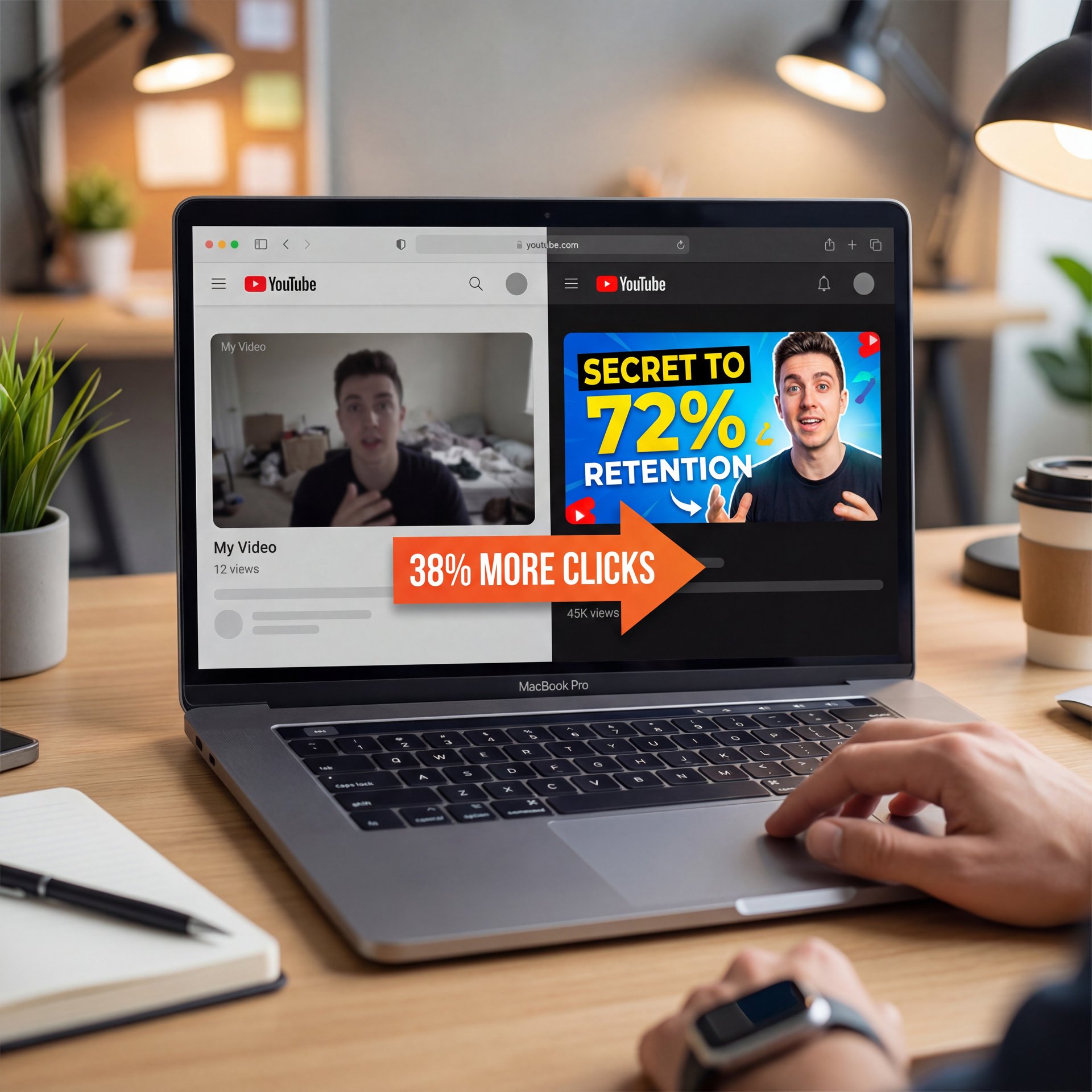
I mean, you can have the best Veo 3.1 generation in the world, but if the packaging looks boring, the engine never gets to start. In 2025, 72% of YouTubers are using AI-edited thumbnails, and they’re seeing a 38% uplift in clicks compared to non-AI thumbnails.
If you’re just grabbing a random frame from your Veo generation and slapping some text on it, you’re leaving money on the table. You need to compose that image separately.. Seriously.
I prefer to use tools that let me control the elements. You want high contrast, clear faces, and immediate curiosity. At Banana Thumnail, we focus on this exact problem, getting the click so the video actually gets seen.
The Power of Visual Hooks
But let’s go under the hood of the video itself. What keeps them watching?
Hooks.
You need a visual hook in the first 3 seconds. Since Veo 3.1 can generate pretty wild visuals, use that to your advantage. Start with something impossible. a car flying, a building melting, a dog in a spacesuit.
FlowGrid Analytics actually did a case study on this. They increased their 30-second retention from roughly 41% to 63.9% just by using Veo 3.1 avatar hooks combined with human-edited screens. They didn’t use only AI video; they used AI to grab attention, then switched to real value.
Don’t Rely on Raw Output
Raw AI video often lacks “sound design.” Veo 3.1 has native audio generation now, but it can still feel a bit flat. Always layer your own sound effects (whooshes, risers, ambient noise) in post-production. It makes the 8-second clips feel connected rather than isolated. Check out our Sora 2 Guide for more on audio-visual syncing in AI.
Can You Make Professional Ads with Veo 3.1?
Now, if you’re trying to make money with THIS, you’re probably looking at ads.
I’ve had people ask me, “Can I really replace my videographer with this?”
Well, yes and no.
A regional e-commerce brand tested this recently. They swapped out their generic stock footage for AI-generated product scenes using Veo. The results were pretty crazy. They saw their View-Through Rate go from close to 22% to 34.8%. Even better, their CTR rose by 60.4%.
Why? Because they could make the video specific to the product. Instead of “generic happy woman holding box,” they could generate “woman holding [Specific Brand] box on Mars.”
The Consistency Challenge
(Let me rephrase that.)
But here’s the catch. consistency.
If you need a recurring character, Veo 3.1 is better than the old versions, but it’s not perfect – like, really perfect. Google reported that Veo 3.1 avatars in Google Vids are now preferred like 5x more often than competitor avatars in internal testing. That’s a good sign, but you still need to be careful.
If you’re doing a 30-second spot, I’d recommend using the avatar for the “talking head” portion and covering the rest with B-roll. Don’t ask the avatar to walk around, do backflips, and cook dinner. The physics will glitch and you’ll lose the viewer.
Also, keep an eye on the platform. 58% of YouTube ads are now AI-generated or AI-edited in 2025. The bar is raising. If your ad looks “glitchy,” people associate that with a “glitchy” product.
Veo 3.1 vs The Competition: Is It Worth It?
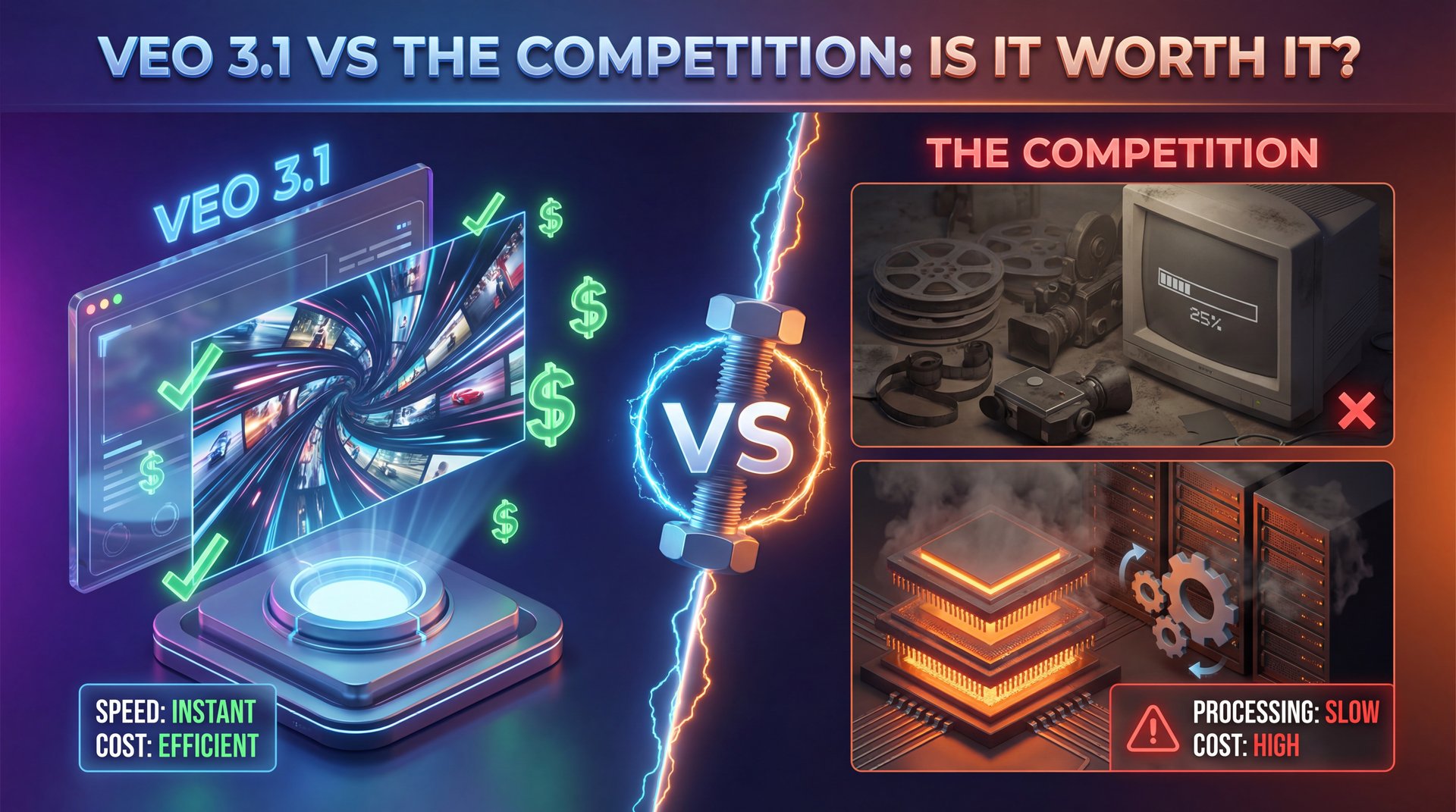
So, is Veo 3.1 the right tool for the job or should you be looking elsewhere?
There are a lot of tools out there like Synthesia, and honestly, it can get confusing. But here’s how I see Veo stacking up against the usual suspects right now.
The big win for Veo 3.1 is the integration with the Google system & the “Enterprise-grade” focus. It’s built to be safer for work.
But if you need a 10-minute documentary style video, you might struggle with just Veo. You’d need to generate hundreds of clips.
I found that for interactive content, though, it’s a beast. Beam launched a platform where users produced 4.7 times more interactive projects using Veo 3.1. Because the clips are short, they work great for “choose your own adventure” style videos or quick social loops.
(Before I forget…)
Also worth mentioning: 52% of TikTok and Instagram Reels are created with AI video tools in 2025. So if you’re not adapting to these workflows, you’re already behind.
How to Build a Workflow That Actually Converts (seriously)
So, how do we put this all together into a workflow that doesn’t drive you crazy?
(Hard to say.)
Curtis, the founder over here at Banana Thumbnail, always talks about “systems over hope.” You can’t just hope the AI gives you a good result. You need a system.
Here’s what you want to do:
- **Script First:** Don’t touch Veo until you have a script. Know exactly what shots you need. 2. **Prompt Specifics:** Use camera terminology. “Low angle,” “wide shot,” “bokeh,” “golden hour.” The AI understands these. 3. **Generate in Batches:** Don’t generate one clip, edit it, then go back. Generate 10 variations of Scene 1. Pick the best one. 4. **The Thumbnail:** While you’re generating, think about your thumbnail. If you get a really cool frame, save it. Or better yet, grabbed a dedicated tool to build a high-CTR thumbnail separately. five. **Edit Human:** Use a real video editor (Premiere, Davinci, CapCut). Add your music, your voiceover, and your effects.
I’ve seen so many creators skip step 4, and it kills them. If you want to dive deeper into how to turn your rough ideas into polished visuals, check out our Pro Sketch to Render Workflow. It applies just as much to video planning as it does to static images.
Need a Workflow Upgrade?
If you’re tired of guessing which images will get clicks, check out Banana Thumbnail’s Features. We help you generate and improve thumbnails that actually stop the scroll, so your Veo 3.1 videos get the audience they deserve.
And don’t forget the audio. I mentioned this earlier, but it’s critical. Dicey audio ruins good video. If the Veo output sounds robotic, strip the audio and use a separate AI voice tool or, better yet, record it yourself.
The “Save My Video” Checklist
Before you publish, ask yourself:
- Did I hook them in the first 3 seconds?
- Are my clips shorter than 5 seconds on average?
- Is there a sound effect for every visual transition?
- Does my thumbnail have a clear focal point?
- Is the story clear even without sound? (Most people watch on mute first).
Look, Veo 3.1 is a capable tool. But it’s just that (a tool). It’s like a high-end wrench. It won’t fix the car by itself, but in the hands of someone who knows what they’re doing, it makes the job a whole lot faster.
Take the time to learn the quirks. Respect the 8-second limit. Focus on your retention stats. If you do that, you’ll stop making “AI videos” and start making surprisingly good videos that happen to use AI.
Thanks for reading, guys. Now get out there and fix those timelines.
Frequently Asked Questions
What are the main challenges users face with Veo 3.1?
The biggest challenges are the 8-second clip limit which forces creators to chain multiple clips and the difficulty in maintaining character consistency across different generations. Beginners also struggle with vague prompts leading to unusable footage that lacks narrative structure.
How does Veo 3.1 compare to other AI video generation tools?
Veo 3.1 focuses heavily on enterprise safety and integration with Google’s system (like YouTube Shorts and Google Vids), offering higher fidelity avatars that are preferred 5x more than competitors. However, it requires more manual structure compared to tools that attempt to generate full videos in one go.
What are the key benefits of using Veo 3.1 for video creation?
It significantly lowers production costs (pennies per minute vs. hundreds of dollars) and speeds up the creation of B-roll and product scenes. It also allows for rapid testing of visual concepts, which can boosted ad performance metrics like View-Through Rate and Click-Through Rate.
What are the main challenges users face with Veo 3.1?
The biggest challenges are the 8-second clip limit which forces creators to chain multiple clips and the difficulty in maintaining character consistency across different generations. Beginners also struggle with vague prompts leading to unusable footage that lacks narrative structure.
How does Veo 3.1 compare to other AI video generation tools?
Veo 3.1 focuses heavily on enterprise safety and integration with Google’s system (like YouTube Shorts and Google Vids), offering higher fidelity avatars that are preferred 5x more than competitors. However, it requires more manual structure compared to tools that attempt to generate full videos in one go.
What are the key benefits of using Veo 3.1 for video creation?
It significantly lowers production costs (pennies per minute vs. hundreds of dollars) and speeds up the creation of B-roll and product scenes. It also allows for rapid testing of visual concepts, which can boosted ad performance metrics like View-Through Rate and Click-Through Rate.
Word Count: 1,847 words
Related Videos


Related Content
• fail
• fail
For more on this topic, check out: fail
Listen to This Article
![Why Your Veo 3.1 Videos Fail [Creator Fixes] - AI video tools, video retention rate, YouTube thumbnails guide](https://blog.bananathumbnail.com/wp-content/uploads/2025/12/gemini_3_pro_image_Why_Your_Veo_3_1_Videos_Fail__-150x150.jpg "AI Creative Studio")
